The input temperature argument is internally converted into its equivalent on the Kelvin (K) scale and then that value is, in turn, converted into its equivalent on all the other scales and the computed results displayed.
Applying the mathematical definition, absolute zero means the absence of all heat, thus there cannot be any negative temperatures on either of the absolute (K or R) scales. The program will report temperatures that equate to below absolute zero as an error.
- Let:
F = Degrees Fahrenheit
C = Degrees Celsius
K = Degrees Kelvin (kelvins) = Degrees C above absolute zero
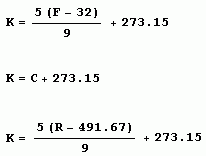
R = Degrees Rankine = Degrees F above absolute zero - First, the K-scale equivalent of the given temperature is computed according to whichever one of the following formulas apply.
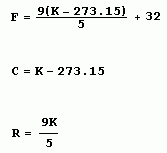
- Then, the K-scale temperature value equivalents on the other three scales are computed according to the following formulas.
NOTES ON THE TEMPERATURE SCALES:


--------------------
F = Fahrenheit scale

    Invented by the German-Dutch physicist
    Gabriel Daniel Fahrenheit in 1724.

    It is based on the difference between the
    freezing point and boiling point of water
    being divided into 180 equal degrees.

    Ideal freezing point of water =  32 F
    Ideal boiling point of water  = 212 F

    Plotted on a circle, the freezing and
    boiling points are opposite each other
    by ±180 degrees.


-----------------
C = Celsius scale

    Invented by Swedish astronomer Anders
    Celsius in 1742.

    It is based on the difference between the
    freezing point and boiling point of water
    being divided into 100 equal degrees.

    Ideal freezing point of water =   0 C
    Ideal boiling point of water  = 100 C


----------------
K = Kelvin Scale

    Named after the British mathematician and
    physicist William Thomson Kelvin, who first
    proposed it in 1848.

    It is commonly used in advanced scientific
    computations.

    It is often referred to as the absolute
    temperature scale.

    The absolute K scale is measured in Celsius
    degrees from the absolute zero point.

    Absolute zero refers to the theoretical
    temperature at which molecular energy
    is at a minimum or theoretically, the
    lowest possible temperature in nature.

    On the K scale, there is no such thing as
    a negative temperature value.

    Ideal freezing point of water = 273.15 K
    Ideal boiling point of water  = 373.15 K


-----------------
R = Rankine Scale

    Named after the Scottish engineer and
    physicist William John Macquorn Rankine,
    who first proposed it in 1859.

    The absolute R scale is measured in
    Fahrenheit degrees from the absolute
    zero point.

    Absolute zero refers to the theoretical
    temperature at which molecular energy
    is at a minimum or theoretically, the
    lowest possible temperature in nature.

    On the R scale, there is no such thing as
    a negative temperature value.

    Ideal freezing point of water = 491.67 R
    Ideal boiling point of water  = 671.67 R


--------------------------
Absolute zero equivalents:

0.00 K  =  0.00 R  =  -273.15 C  =  -459.67 F


------------------------------------------------------
The ratio of Celsius to Fahrenheit degrees is 5 to 9.

This means that a temperature difference of 5 degrees
on the Celsius scale is equivalent to a difference of
exactly 9 degrees on the Fahrenheit scale.  This is
the source of the ratios 5/9 and 9/5 used in the
interconversion formulas.

------------------------------------------------------
The Fahrenheit and Celsius scales are numerically
identical only at -40 degrees, while the Kelvin and
Rankine scales are numerically identical only at
absolute zero.